Mecha Digi: a mechanical and a digital watch on one Garmin face
Mecha Digi puts two watches on one dial. The left half is mechanical, with a spring, a chain of wheels and a balance that swings back and forth, while the right half is digital, with a battery, a chip and amber digits. A single swinging weight at the top, the rotor, powers both.
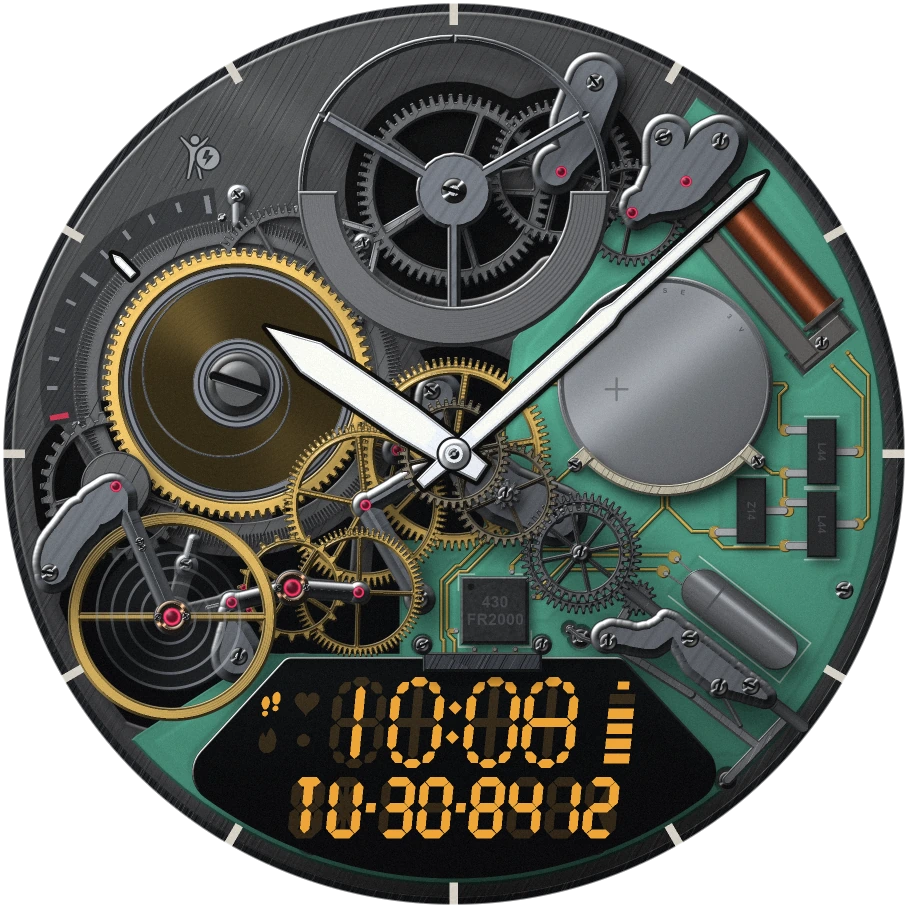
None of it is real, but I drew every part to have a reason to be there, as if somebody had to build it. This is a walk round the dial, part by part.
Has anyone built this?
In a Seiko Kinetic the swinging weight of a self-winding watch drives a tiny generator, which charges a battery. A Seiko Spring Drive runs on a spring while a quartz crystal keeps it on time. Neither shows any of this on the dial.
What I could not find is one that shows everything on the front, with the wheels, the electronics and a digital display side by side. The closest is The Electricianz Hybrid, which has its mechanism on show and LEDs behind the dial, though the LEDs only light it. No Garmin face I found does it either, so there was nothing to copy.
The layout follows one rule: whatever one half has, the other half has too, at the same height where it can. The spring on the left stores energy and so does the battery on the right. The balance on the left keeps time, as the quartz crystal does on the right. Each half also shows the time in its own way, the mechanical one with the hands and the electric one on the display.
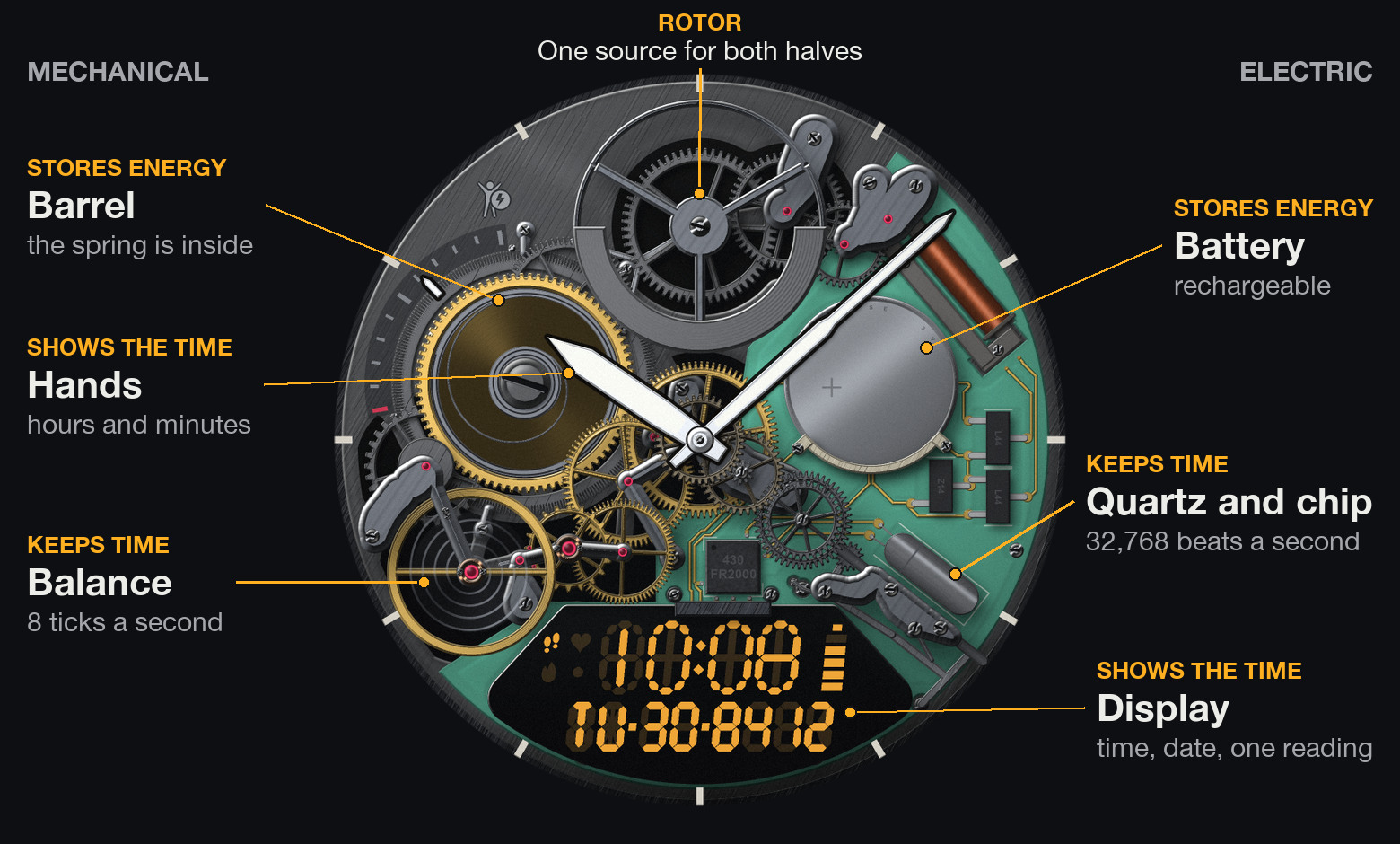
The rotor
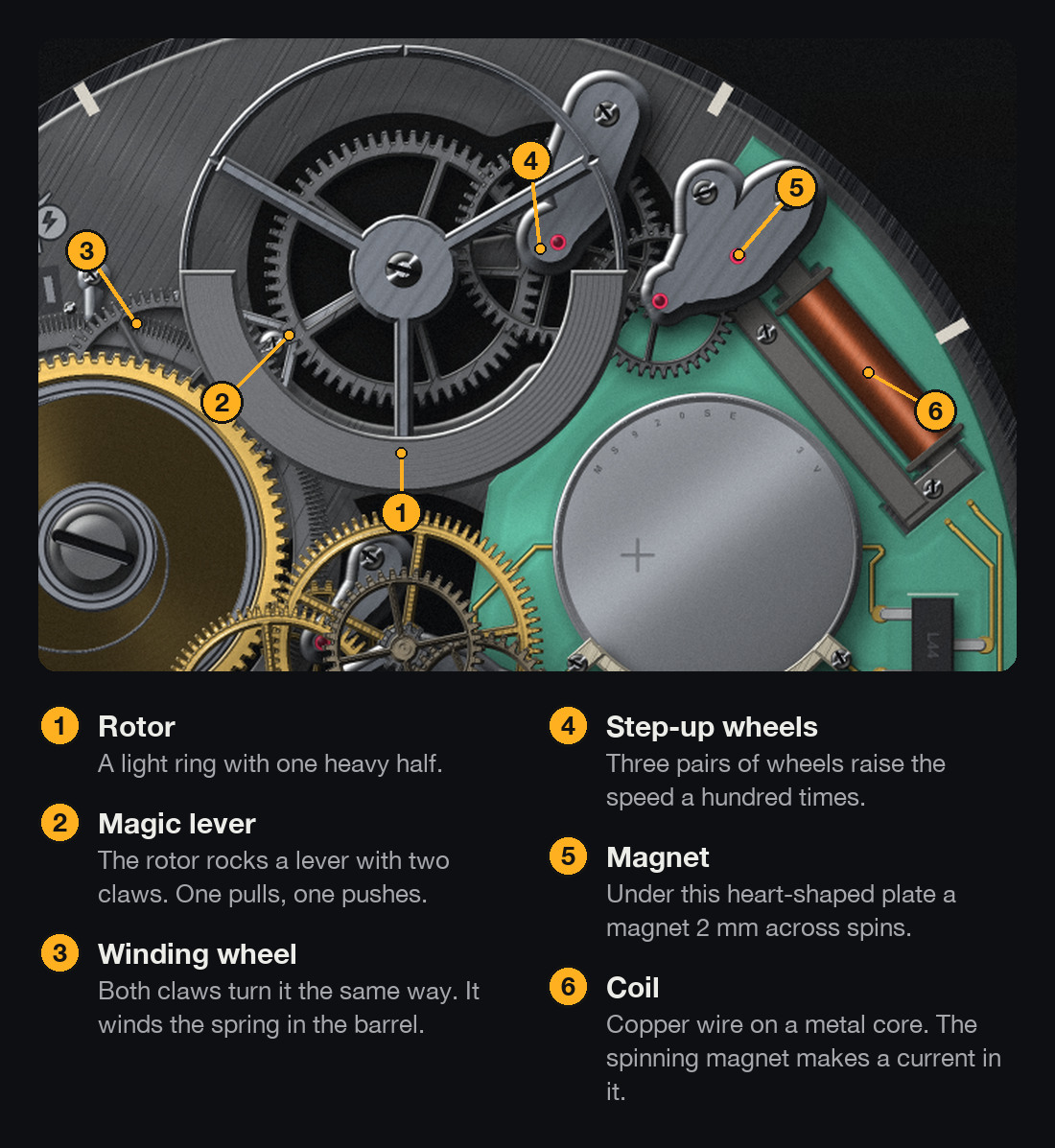
The rotor is the ring at the top with one heavy half. In a self-winding watch it swings whenever you move your arm, and here it swings when you raise your wrist.
To its left, partly hidden under it, a small lever with two claws turns that swinging into winding. When the rotor swings one way the first claw pulls a wheel round. When it swings back, the second claw pushes the same wheel on in the same direction, so the spring is wound either way. Seiko came up with this in 1959 and called it the magic lever.
To its right the rotor makes electricity. The toothed wheel you can see through it is fixed to it and drives a few smaller wheels, which speed the motion up a hundred times. The last of them carries a tiny magnet, hidden under the heart-shaped plate, because a magnet spinning next to a coil of copper wire makes a current. That coil is the copper bar at the top right, the same arrangement a Kinetic uses to charge itself.
The mechanical half
The big gold wheel on the left is the barrel, with the mainspring coiled up inside. As the spring unwinds it turns the barrel once in eight hours.
From there the motion passes along a chain of wheels, each turning faster than the one before. The wheel in the centre of the dial turns once an hour and carries the minute hand, while a few small wheels under the hands slow that down twelve times for the hour hand. At the end of the chain is the smallest one, the escape wheel, turning twelve times a minute.
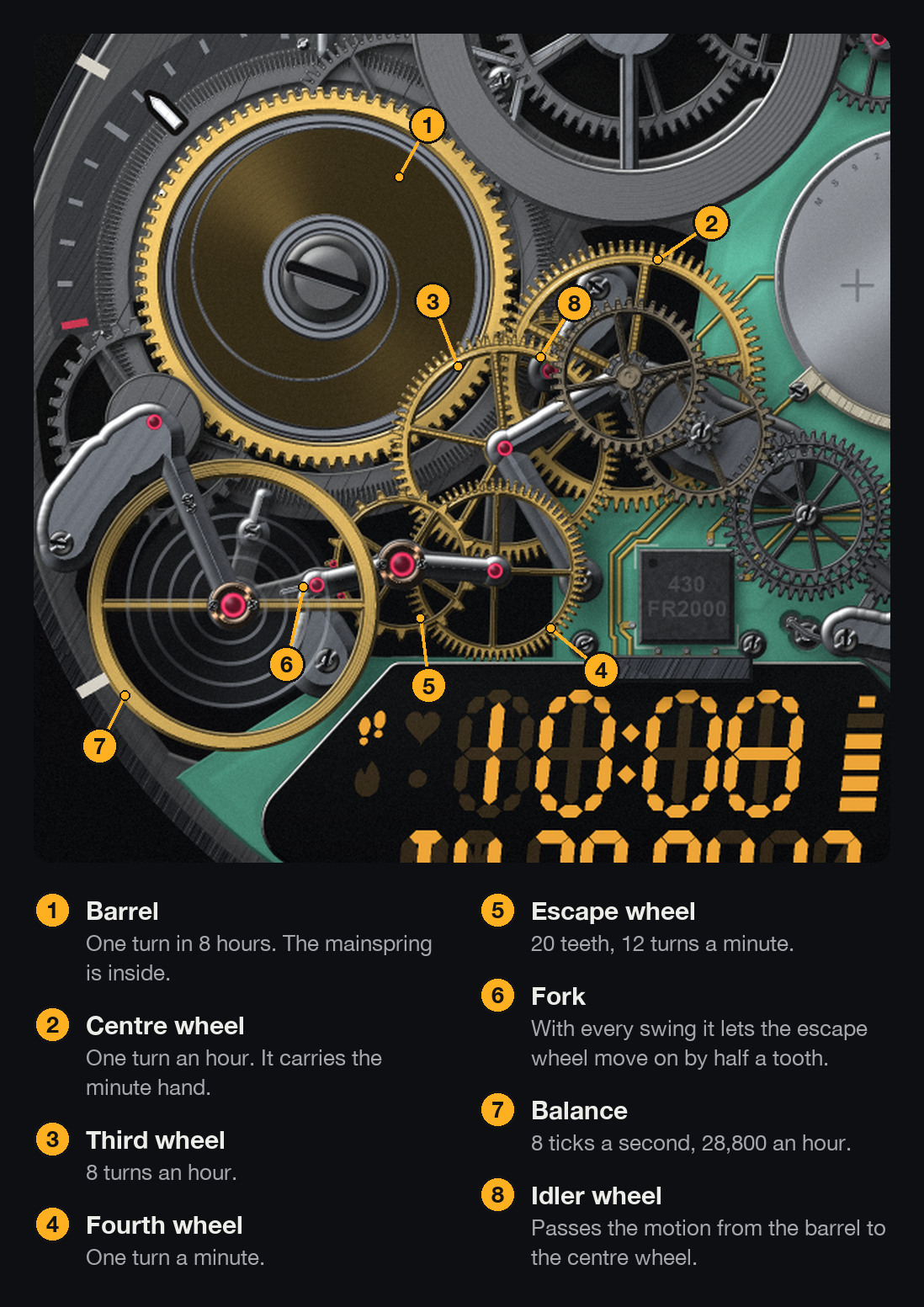
If nothing held the escape wheel back, the spring would run down in seconds. What holds it back is the balance, the gold ring at the lower left that swings back and forth on a fine spiral spring. With every swing a small fork lets the escape wheel slip forward by half a tooth, which is the tick you hear in a mechanical watch, eight times a second in this one.
On your Garmin the whole mechanism runs at these speeds for a few seconds each time you raise your wrist. Then the balance slows to one tick a second, and the wheels are moved on once a minute, like the hands. Because I counted the teeth of every wheel before drawing anything, they always fit into each other.
The gauge
The first person who wrote to me about this face liked it, and had a few suggestions. One was about the curved scale at the upper left, which to him felt a little out of place beside the mechanism. On a small screen it is easy to miss that there is a mechanism under it too.
Garmin owners want their numbers on the dial, like Body Battery or steps. A mechanical watch has one number of its own, how far the spring is wound, and some show it on a small scale called a power reserve. So I built the gauge the way a power reserve is built. On your wrist it shows Body Battery or another reading you pick, named by the small symbol above the scale.
Under the barrel lies a thin steel ring with fine teeth all the way round. The pointer is a small needle fixed to that ring, so when the ring turns a little, the pointer moves along the scale.
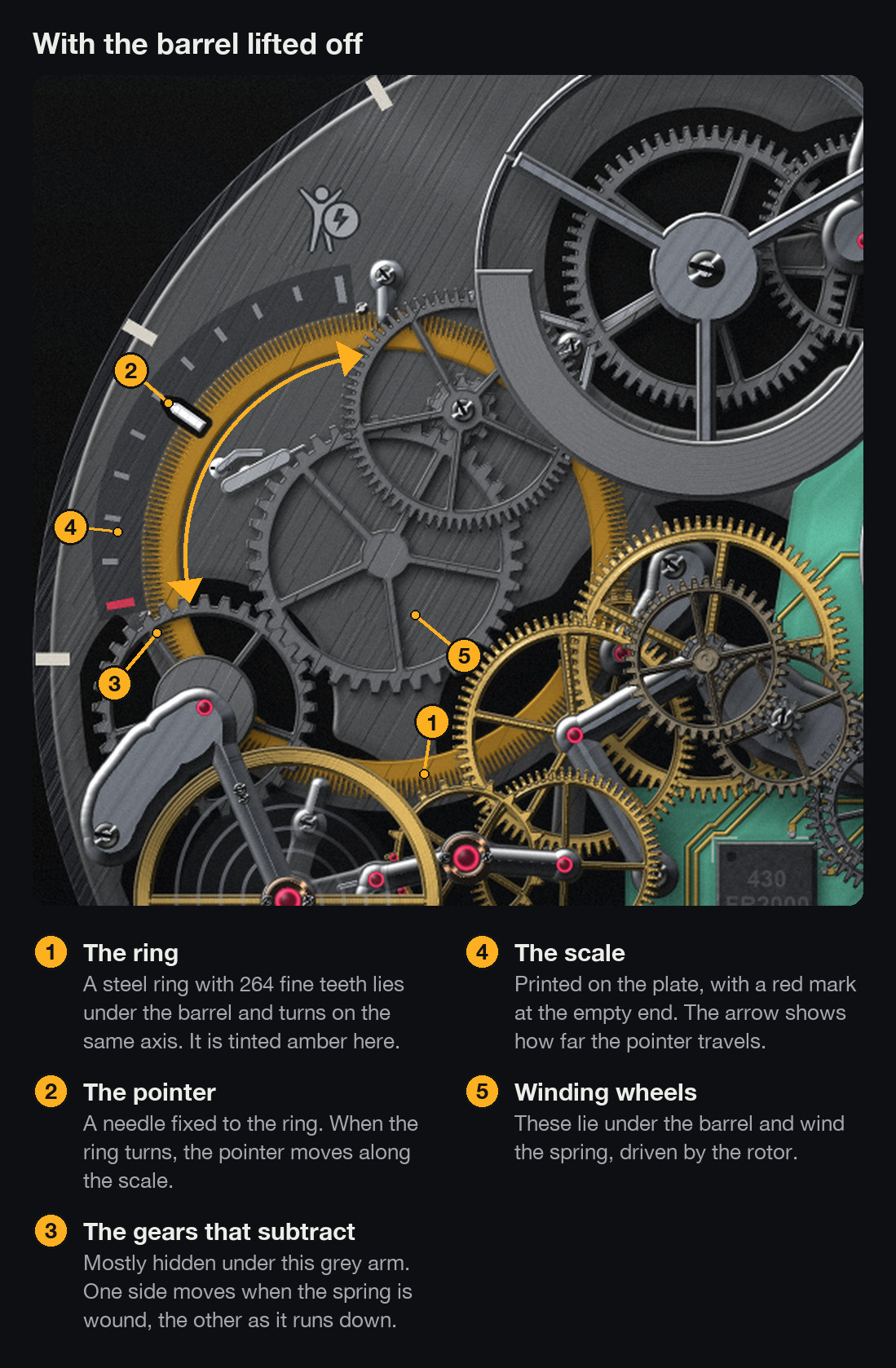
A few small gears, tucked under the grey arm at the lower left of the picture, turn the ring. They are driven from two places, by the winding and by the barrel as it unwinds, and they pass on only the difference between the two. In a real watch the pointer would therefore rise with winding and creep back down as the hours pass.
The spring inside the barrel follows the gauge as well. Its coils gather tightly round the centre when the reading is full and lie loose against the wall when it is empty, whichever reading you chose.
The electric half
The current from the coil changes direction with every turn of the magnet, but a battery needs it to flow one way. The three small black parts beside the battery take care of that. Two of them form a rectifier, which lets the current through in one direction only. The third is a Zener diode, which keeps the battery from being overcharged.
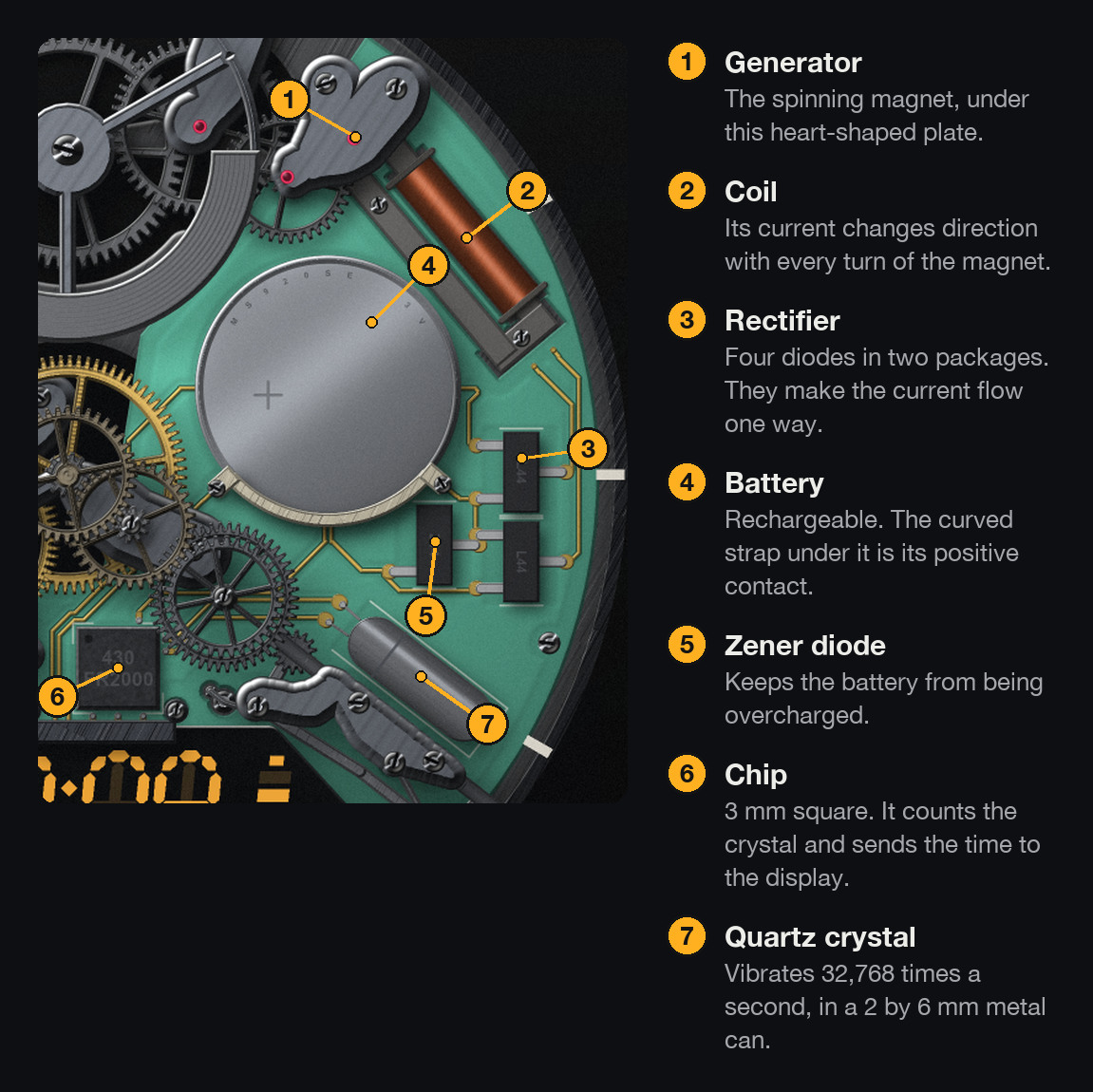
The silver disc is the battery, and since it is rechargeable, the idea is that you never change it yourself. A watchmaker swaps it at a service, perhaps once in ten years, which is what the two screws at the ends of the curved strap under it are drawn for.
Timekeeping on this side starts with the small metal cylinder, a quartz crystal that vibrates 32,768 times a second. The square black chip just above the display counts those vibrations to work out the time. All of these are real parts, drawn at their true sizes, and you can follow the thin gold lines of the wiring from one to the next.
The display
The digits look like an old LCD because that is what they are meant to be, the kind with bright segments on black glass. An LCD needs almost no power, which suits the little charge a small rotor can give, whereas glowing LED digits would empty the battery. If you look closely, the unlit segments show faintly behind the lit ones.
The top row is the time, and under it are the weekday, the date and one reading you choose, such as steps or heart rate, with four small signs on the left to say which. The bars on the right show your Garmin's battery. Amber is the colour it comes in, but the settings also have aqua and ice.
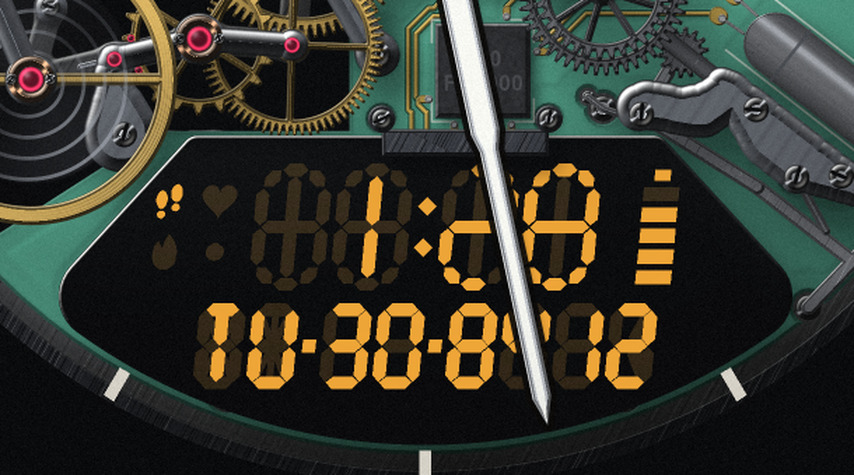
For a few minutes every hour the long minute hand lies across the digits. I left it that way, since the time is on the dial twice and one of the two can be covered for a moment.
What holds it together
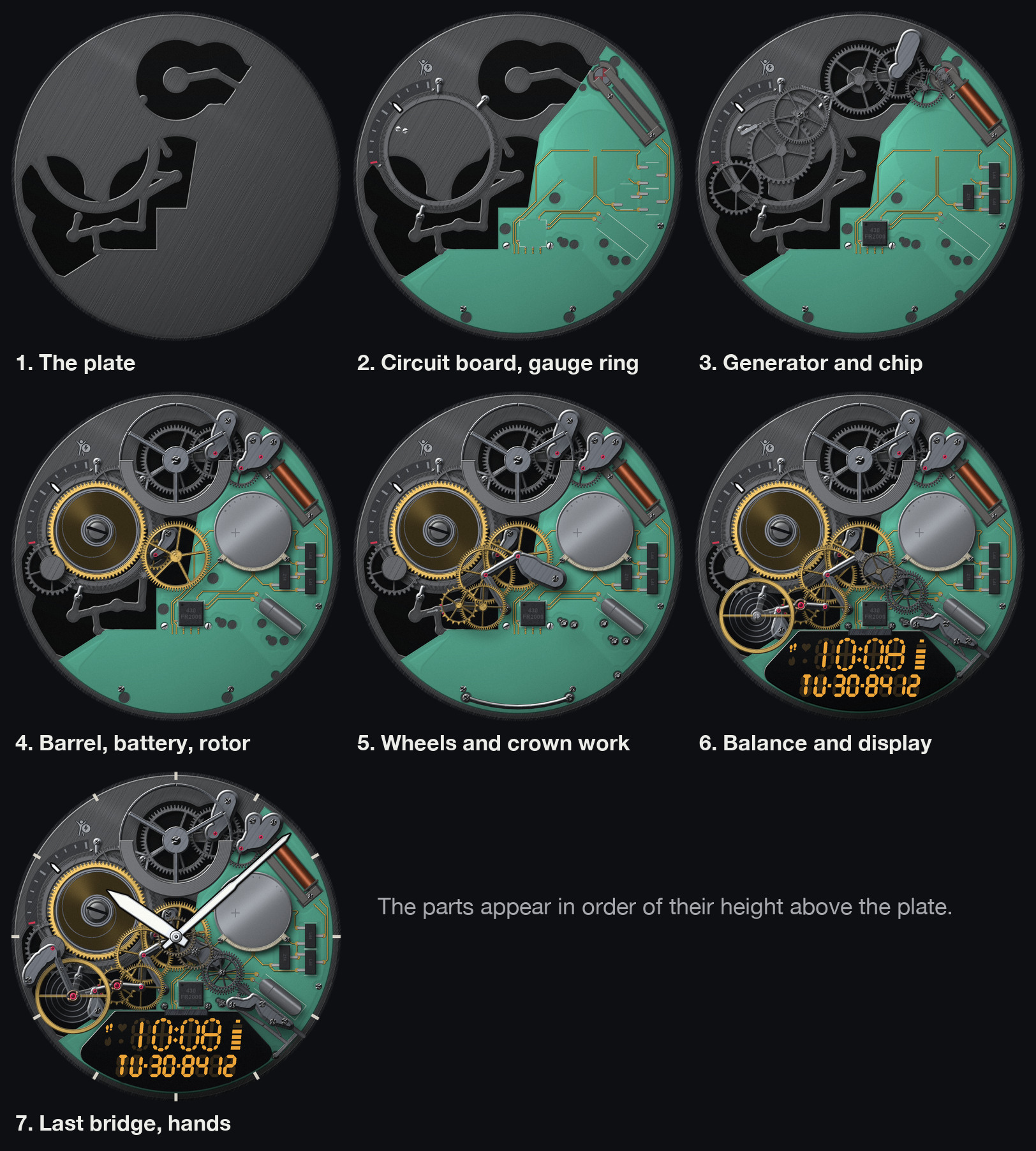
In a drawing a wheel can hang in the air with nothing under it, but here everything is fixed to something. Underneath is one metal plate that fills the case, with a window cut out under each wheel you are meant to see, and the green circuit board is screwed onto it. Every wheel turns in a bearing, marked by a small red dot, which is a jewel, as it would be in the real thing.
Reaching over the wheels are the grey arms and plates called bridges, which hold the top end of each axle. I worked out how thick each has to be to survive a drop from one metre and then made it as narrow as that allows, so that it hides as little as possible. The barrel has no bridge at all, because every one I tried covered part of it, so it is held from below only.
The rod at the lower right is the stem of a crown, the knob you would pull out to set the time. It points to four o'clock, where my Venu 3 has its lower button, and the dark wheels on the green board to the right of the centre are the ones that would turn the hands. The pictures below build the dial up in layers, from the bare plate to the hands.
Where it stops being a watch
The white hands and the twelve white marks round the edge are plainly not metal. Metal hands were another of that reader's suggestions, and a fair one, but I kept them white for two reasons.
The first is that the time has to be readable. On a real watch you turn your wrist a little and a polished hand flashes, whereas a screen shows one fixed picture, and in always-on mode a dim one. So I test every face I make for how quickly you can read it on a small screen in bad light, and white hands with a dark edge are there to pass that test.
The second reason is memory, because each wheel is a separate small picture that the Garmin turns. That works for a round wheel, which looks much the same whichever way it is turned. A long polished hand does not, since its bright edge would end up on the wrong side as it went round, so it would need a different picture for every minute. There are two to four megabytes for all the pictures, and the dial already uses about two.
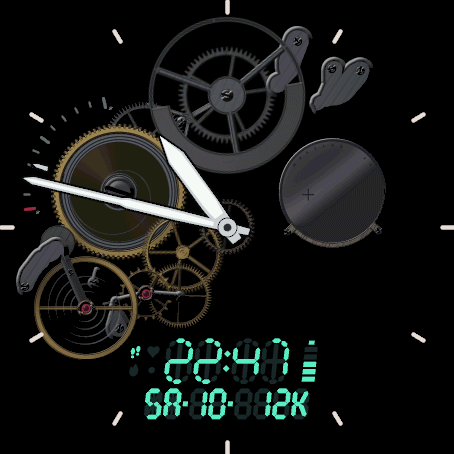
In always-on mode the screen may give out only about a tenth of its normal light, so the plate and the circuit board go black. The wheels, the rotor, the balance and the battery stay, only dimmer, while the digits keep the colour you chose.
Two parts of the dial would not do their job as drawn. The rotor is small, and by my rough estimate it has about a ninth of the force of the weight in a real Kinetic, which is enough to wind a spring but would charge a battery far more slowly. The other is the Zener diode beside the battery. A real design would have a charging chip there, because a Zener lets a little current leak past all the time and would flatten the battery within days.
I wear this face every day, and most of what I described is too small to notice on the wrist. But it is all there, and now you know where to look. Mecha Digi is on the Connect IQ store.
The author builds the My Day 24 watch face family. Published 2026-11-23.